Follow the pattern along the wood
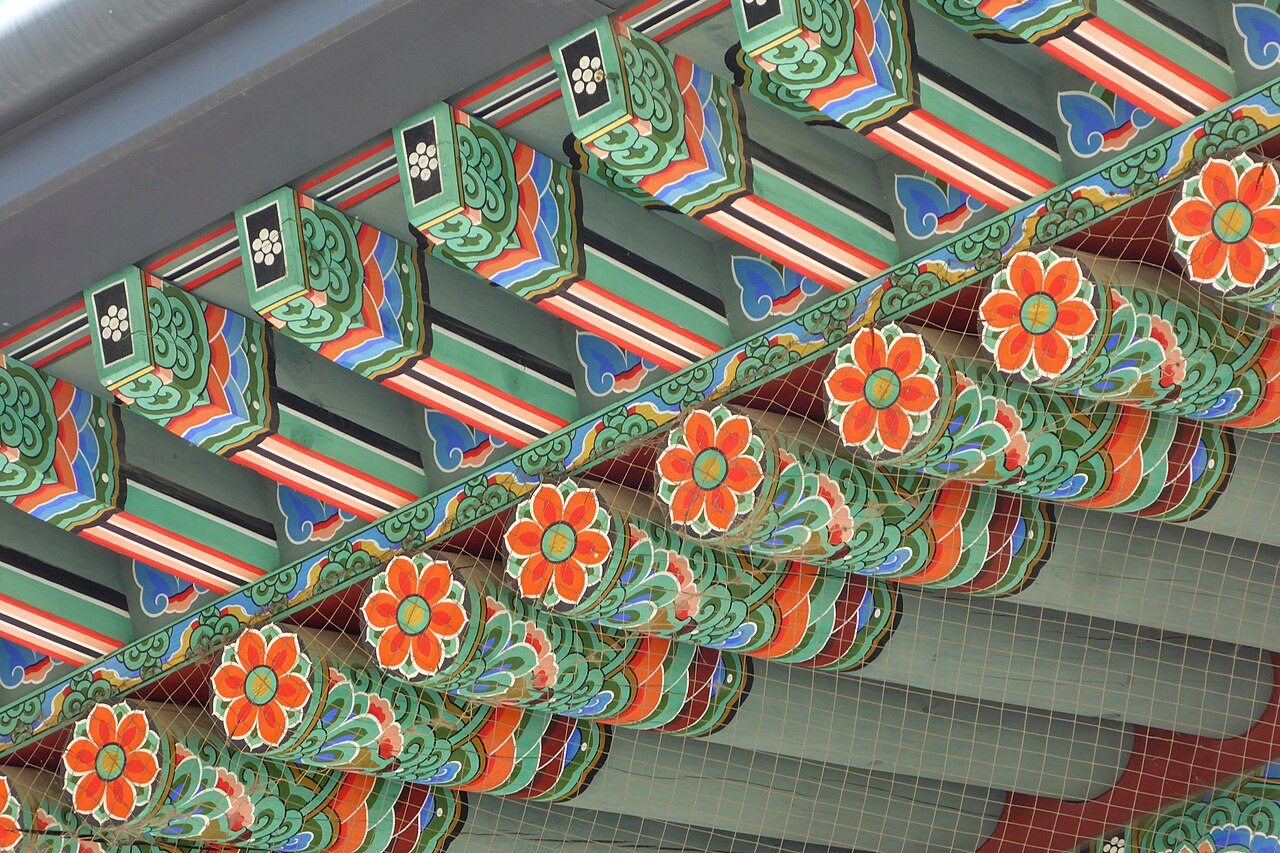
Dancheong is decorative painting on wooden buildings. At Bongeunsa’s Beopwangru, stripes follow the timber and flower-like forms repeat beneath the eaves. Look closely at three details.
1 · A pattern at the end
Find a dark rectangular end with a small, pale flower-like pattern. Similar ends repeat across the photograph.
Making sense of it: The painted shapes help the repeated pieces of timber stand out as a group.
2 · Stripes along the timber
Follow the red, pale and dark bands between those ends. They run along the wood rather than across the whole scene.
Making sense of it: Color follows the building’s structure. The craft combines decoration with protection of the timber.
3 · A row of flower-like forms
Trace the orange-red forms across the lower row, then compare them with the smaller pale forms above.
Making sense of it: Repetition connects small details with the larger rhythm of the eaves. Looking at shape and placement is a first step toward discussing a particular motif.
Read the source: MCST · Dancheongjang: Master of Color and Pattern ↗ · Checked 3 October 2026.
About this reading & its sources
The photograph shows Beopwangru, not the Daeungjeon courtyard used in our temple-spaces guide. Our labels describe visible forms, not identified historical motifs. The image does not establish the paint’s age, ingredients or restoration history.
Looking prompts and interpretations are our editorial contribution, not expert certification.
Does bright paint mean the whole hall is new?
No. A building and the care of its painted surfaces can have different histories. Look for a dated conservation record before dating either from color alone.
Color follows the building
Dancheong combines ornament with care for wooden architecture. It appears on temples, palaces and other important buildings. Color can also mark the importance of a space.
Follow one painted band along a piece of timber. Then find the next piece with a similar pattern. The decoration helps you see how separate parts form a larger structure.
A craft kept alive through practice
Dancheong depends on skills passed between practitioners. The craft was recognized as intangible heritage in 1972. Its history continues through the people who carry out the work.
Fresh paint and an old building can belong together. A conservation record helps explain when the building was constructed and when its painted surfaces were renewed.
From a detail to the whole
In the close-up, compare a pale flower-like form on a dark end with the larger orange-red forms below. Their different sizes are easy to miss from a distance.
Next, follow the repeated shapes across the eaves. What first looked like a single colorful surface becomes a sequence of painted parts. A local explanation can add the names and meanings of particular motifs.
Words you will meet
- 단청 · Dancheong
- Ornamental painting of architectural surfaces.
- 단청장 · Dancheongjang
- The skilled craft or its practitioner, depending on context.
A few useful distinctions
Is dancheong only used in Buddhist temples?
No. It is also associated with palaces and other important traditional buildings.
Does brighter paint mean a building is not historic?
No. A building and a renewed painted surface can have different dates.
Sources & further reading
Editorial review: · Our editorial approach
- Ministry of Culture, Sports and Tourism · Dancheong craft ↗
- Korea Heritage Service · Dancheong: functions, decoration and symbolism ↗
Scope of this article
Close-looking labels describe visible forms, not a definitive identification of historical motifs. The photograph cannot establish paint age, ingredients or conservation history. The text introduces the craft rather than a restoration method.
References include institutional pages and indexed records. Editorial review does not verify current programs or on-site conditions.
- The relation between paint and timber
- A building and its surface can have different dates