Read a real temple courtyard
A Korean temple is a group of spaces with different roles. In this Bongeunsa photograph, a worship hall faces a stone pagoda across an open courtyard. Learning to separate building, object and gathering space makes the scene easier to read.
- Locate a hall, pagoda and courtyard
- Use a hall name as a clue
- Separate what a photograph shows from what needs another source
Four things to find at Bongeunsa
Select a number to read its explanation. All four are also available in the text guide below.
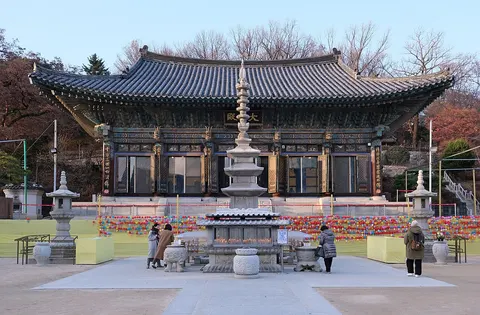
The building behind the pagoda is Bongeunsa’s Daeungjeon. Daeungjeon means Hall of the Great Hero, a title referring to Shakyamuni. This photograph shows its exterior.
Read all four photo explanations
- 1. Daeungjeon · Buddha hall 대웅전
- The building behind the pagoda is Bongeunsa’s Daeungjeon. Daeungjeon means Hall of the Great Hero, a title referring to Shakyamuni. This photograph shows its exterior.
- 2. Painted wooden elements 단청
- Look under the eaves for colored beams and brackets. Dancheong combines protective painting and decorative craft on wooden architecture. This wide view shows placement; follow the craft article to explore its purpose.
- 3. Stone pagoda 석탑
- The central stone structure has stacked tiers. Pagodas have a tradition of enshrining relics or scriptures and represent Buddhist devotion. This photo alone does not establish what this particular pagoda contains.
- 4. Madang · open courtyard 마당
- The open ground lets you see the hall and pagoda together. People move, pause and gather here. A courtyard is part of the temple’s life rather than simply leftover space between buildings.
Three names that help you read a hall
- 대웅전 · Daeungjeon
- Hall of the Great Hero · Shakyamuni Buddha
- 극락전 · Geungnakjeon
- Paradise Hall · Amitabha Buddha
- 대적광전 · Daejeokgwangjeon
- Hall of Great Tranquil Light · Vairocana Buddha
A name is a clue to dedication. Individual temples can have distinctive arrangements; Tongdosa’s main hall is an important example.
Why Tongdosa’s hall is different ↗What can this photograph tell you?
Our close-looking prompts connect the cultural explanation with what you can notice.
Start with the relationship
Find the building behind the pagoda. Then follow the open ground between them. Read this as a relationship between a place of worship, a devotional object and a space where people move and gather.
Look closely, then name it
Under the roof, painted wooden elements have a different material and visual rhythm from the gray stone in front. Precise description is a useful first step toward understanding architecture and craft.
Ask what the image leaves out
You can see an exterior, not an inventory of the hall’s statues or a current ritual. Use a hall name and an institutional description to explore further. That habit is useful for reading any temple photograph.
Continue with the cultural background below, then check the ideas you have learned.
Start with a name, not a size
A precinct can bring several halls and other buildings into one religious place. The Jogye Order’s layout guide explains named gates and halls; the names help connect structures with Buddhist figures and uses. The largest roof does not provide every answer.
Compare the name on a hall with the name of the image in its documented introduction. If they do not make sense yet, keep both names together as a question. Learning a single relationship is a better beginning than memorizing a long list of unfamiliar terms without context.
A hall can contain another architectural layer
The National Institute of Korean History introduces datjip, a canopy around or above the Buddha image. Looking inside a hall can therefore reveal a smaller architectural frame within the larger building. Religious attention and crafted structure meet at more than one scale.
Use a documented photograph or a permitted view to compare roof, interior frame and image. Our drawing prompt is to place one outline inside another. It is a study of relationships, not a measured plan or an instruction to enter a restricted interior.
Worship is not the only function on the grounds
Study, meditation and residential life belong to a working monastery alongside worship. A building whose function is not obvious to a visitor need not be an unused monument. A precinct makes more sense when the community’s life is included in the account.
Read the courtyard as a connection between these uses rather than a checklist of attractions. Which functions do the signs or guide explain, and which remain unknown? That difference is a starting point for cultural curiosity. Not knowing a name yet does not make the space meaningless.
What will you remember?
Try three short questions. Change an answer or open the explanation whenever you like. Nothing is saved to your browser.
0 of 3 questions explored.
Words you will meet
- 법당 · Beopdang
- A Buddhist worship or Dharma hall.
- 닫집 · Datjip
- An architectural canopy framing the enshrined Buddha image.
A few useful distinctions
Is the biggest building always the only important one?
No. Function, religious context and relationships between spaces matter alongside size.
Is the conceptual space diagram an actual temple plan?
No. It is a learning model; individual precincts have their own layouts.
Sources & further reading
Editorial review: · Our editorial approach
- Jogye Order · Korean Temple Layout ↗
- National Institute of Korean History · Buddhist Temple Architecture ↗
Scope of this article
Source-based cultural introduction with editorial observation prompts; not a ritual instruction, program timetable or on-site inspection.
References include institutional pages and indexed records. Editorial review does not verify current programs or on-site conditions.
- Public worship and private monastic spaces
- How the terrain relates to buildings
- The difference between worship, study and community life