Who is in the painting?
A Buddha is an awakened one; a bodhisattva is associated with the path to awakening and helping beings. Compare these two Korean paintings from The Metropolitan Museum of Art: one brings three figures together, while the other centers on a single, monk-like figure.
Amitabha triad
아미타삼존도 · Goryeo dynasty
Around the 13th century
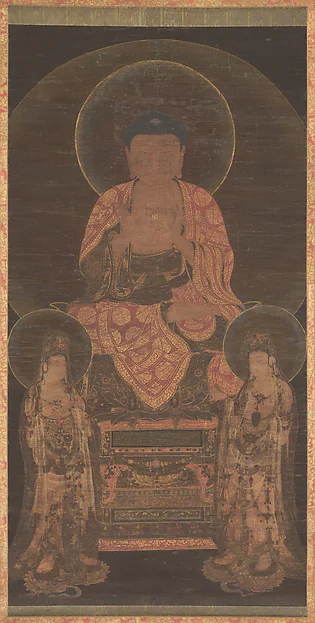
The Met, 30.76.298. Rogers Fund, 1930. Public-domain image; resized/WebP encoded, not cropped. Museum record & larger images ↗
Amitabha sits above two bodhisattvas, Avalokiteshvara and Mahasthamaprapta. Together they form a triad: a group of three.
- Find the seated Buddha
Begin with the figure above the two attendants. The museum connects his hand gesture with teaching Buddhist law.
- Compare the attendants
Both bodhisattvas stand below Amitabha. Their positions make the group easy to recognize as a triad.
- Follow the gold
Look for circular patterns on the central robe. The artist used gold alongside ink and color on silk.
Kshitigarbha · Jijang
지장보살도 · Goryeo dynasty
First half of the 14th century
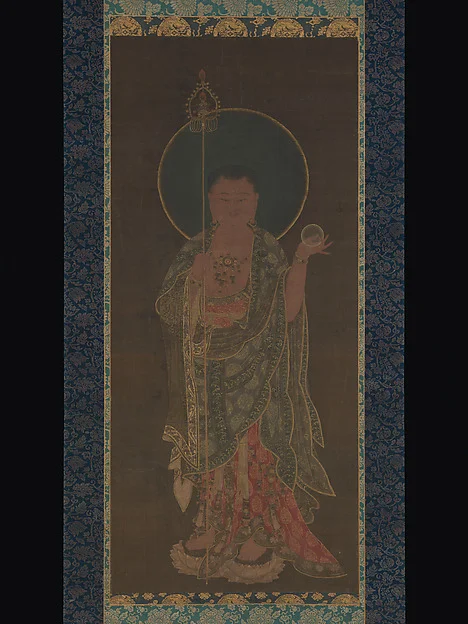
The Met, 29.160.32. H. O. Havemeyer Collection, Gift of Horace Havemeyer, 1929. Public-domain image; resized/WebP encoded, not cropped. Museum record & larger images ↗
Kshitigarbha, called Jijang in Korean, is a bodhisattva associated with compassion for suffering beings. Here he appears in a monk-like form.
- Notice the head and robe
A shaved head and monastic clothing give Jijang his monk-like appearance. He is a bodhisattva, rather than a portrait of an ordinary monk.
- Find the staff and jewel
Follow the tall staff upward, then find the round jewel in the raised hand. The museum identifies both as Jijang’s attributes.
- Compare with the triad
One standing figure fills the center. How does that change your attention compared with the three figures in the other painting?
Try it: does a monk-like appearance always mean a portrait of a monk?
No. Jijang is the counterexample here: a bodhisattva represented in a monk-like form. Appearance is a clue; the documented name and attributes help establish identity.
About these works & their identification
Museum records provide the names, dates and attributes; the looking prompts are ours. These are collection objects, not photographs of current temple interiors. They do not establish an altar arrangement.
A name gives you a starting point
Buddha means an awakened one. Shakyamuni is the historical Buddha; Amitabha and Vairocana are other buddhas with important places in Buddhist devotion. A bodhisattva follows the path of awakening for the benefit of beings.
Start with the name on the object label. Then look at posture, clothing and accompanying figures. The two paintings above show why a seated figure and a monk-like figure need different explanations.
Gwaneum, Guanyin and Kannon
Avalokiteshvara, the bodhisattva associated with compassion, is called Gwaneum in Korea, Guanyin in China and Kannon in Japan. You may already know the figure by one of these names.
The names connect traditions across languages. Individual images still differ in material, posture and setting. Compare the two attendants in the triad with the single figure of Jijang to see how a composition introduces its subjects.
Read the hall name too
The Jogye Order’s layout guide connects Daeungjeon with Shakyamuni, Geungnakjeon with Amitabha and Daejeokgwangjeon with Vairocana. A hall’s name can be a useful clue to its religious focus.
Pair the hall name with the name given to its central image. If the connection is unclear, ask a guide. The painting behind the statue adds another part of the setting, explored in the companion article.
Words you will meet
- 부처 · Buddha
- An awakened one.
- 보살 · Bodhisattva
- A figure associated with awakening and the benefit of beings.
- 관음 · Gwaneum
- Korean name for Avalokiteshvara, associated with compassion.
A few useful distinctions
Can I identify any figure from its hairstyle alone?
No. Use the object’s documented identification and context; appearance alone can be misleading.
Is Gwaneum a completely unrelated figure to Kannon?
The names belong to related traditions of Avalokiteshvara, but particular images and practices can differ.
Sources & further reading
Editorial review: · Our editorial approach
- The Metropolitan Museum of Art · Korean Buddhist Sculpture (5th–9th Century) ↗
- The Metropolitan Museum of Art · Explore Asian Art family guide ↗
- Jogye Order · Korean Temple Layout ↗
Scope of this article
Figure identifications follow the museum’s records; looking exercises are editorial. The Goryeo scrolls are collection objects, not photographs of current temple interiors. Hall names offer context but do not establish every temple’s image arrangement.
References include institutional pages and indexed records. Editorial review does not verify current programs or on-site conditions.
- Hall name and object name
- Documented identification before visual guesses