Understand a Buddhist service
Yebul is a communal Buddhist service of reverence and commitment. Voices and bows express a relationship to the Buddha, the teaching and the practicing community—the Three Jewels.
- Explain the Three Jewels
- Separate a service from recitation
- Recognize a bow as part of worship
Listen, look, then connect the meaning
During yebul, voices and bows express respect for the Buddha, the teachings and the community. Use these three prompts alongside the official video below.
A tool for keeping time: the moktak
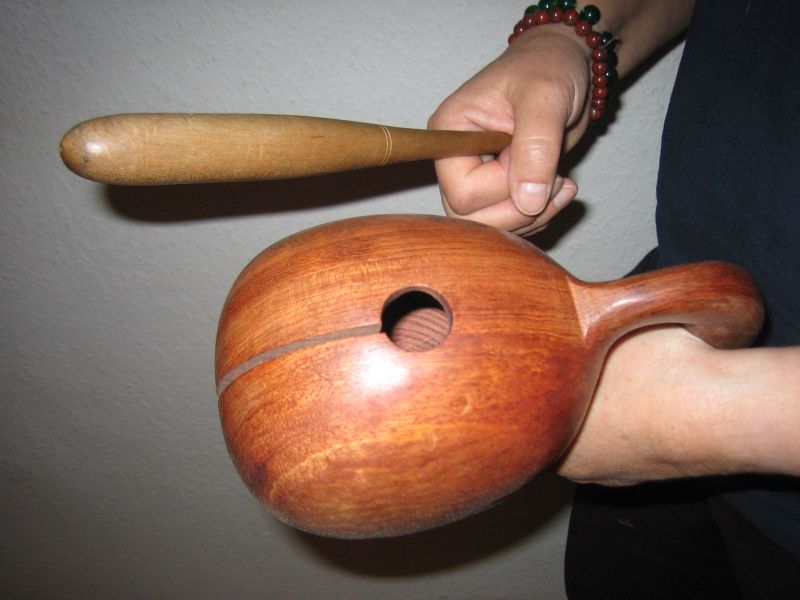
Notice the wooden body, slit and separate beater. The moktak keeps time during chanting and morning or evening services. It helps connect the rhythm you hear with an object you can recognize.
Instrument explanation: Jogye Order · Moktak ↗
Listen: voices join
Notice when one voice becomes several. What changes when people recite together?
Making sense of it: A shared rhythm brings people into a common act of worship.
Look: respect takes a physical form
When people bow, notice where they direct their attention.
Making sense of it: A bow expresses reverence through the body. Palms together, a standing bow and a floor bow are different gestures; the illustrated guide compares them.
Connect: teacher, teaching, community
Keep these three words in mind as you watch: Buddha, Dharma, Sangha.
Making sense of it: These are the Three Jewels. The service connects devotion to the Buddha with the teachings and the community of practice.
Read the source: Official Templestay · activity 05, Yebool ↗ · Checked 3 October 2026.
About this reading & its sources
These are viewing prompts, not a transcript, translation, fixed ritual sequence or verified video timestamps. The separate moktak photograph identifies an instrument; it does not identify the sound in a particular video passage. Visitor participation follows the host’s guidance.
Looking prompts and interpretations are our editorial contribution, not expert certification.
What can listening alone establish?
You can notice rhythm and voices joining. A text, reliable captions or a host’s explanation can then help you understand the words.
Watch an official introduction
Yebool — video linked by official Templestay
No video service is contacted until you choose to load it. Loading connects to YouTube, which receives request information such as your IP address; its privacy policy applies.
Open on YouTube ↗ · Official source page ↗
If playback or captions are unavailable, the explanations on this page work independently. Observation prompts are our own; they are not a transcript or a timestamped description.
Continue with the cultural background below, then check the ideas you have learned.
What is the service expressing?
Yebul is a Buddhist service. People gather to express reverence through recitation and bows. The shared actions connect an individual’s practice with a community.
The Three Jewels are Buddha, Dharma and Sangha: the awakened teacher, the teachings and the community of practice. Taking refuge means turning toward them for guidance. These ideas give the service its religious meaning.
Hear the relationship between sound and movement
Yebul is the service; yeombul is recitation, including the recitation of buddhas’ names. Yeombul can take place within yebul or as a separate practice. Chamseon means practicing Seon meditation.
Listen first for voices joining and changes in rhythm. Then use a translation or a host’s explanation to connect the sound with the words. The moktak shown above is one instrument used to keep time.
A bow belongs to a larger practice
Bringing the palms together, bowing while standing and lowering the body to the floor are different gestures. Each can express respect; the illustrated bowing guide shows the differences.
During a service, follow the host’s guidance. If you are unsure about a movement or need a seat, ask before the service begins.
Carry one question beyond the hall
Afterward, try asking: “What did the opening recitation mean?” A question about one moment gives your host a clear place to begin.
Think back to a sound or gesture you noticed. What did the explanation help you understand? You do not need to learn a whole chant to leave with a clearer sense of the service.
What will you remember?
Try three short questions. Change an answer or open the explanation whenever you like. Nothing is saved to your browser.
0 of 3 questions explored.
Words you will meet
- 예불 · Yebul
- A Buddhist service.
- 염불 · Yeombul
- Recitation; not a second spelling of yebul.
- 삼보 · Three Jewels
- Buddha, Dharma and Sangha.
A few useful distinctions
Is yebul a meditation class?
No. A Buddhist service and a guided meditation session have different purposes, although both can appear in temple life.
Must I recite words I do not understand?
Ask your host how visitors participate. Reading here does not establish a requirement to chant or guarantee that observation is available.
Sources & further reading
Editorial review: · Our editorial approach
Scope of this article
A cultural introduction to yebul, not a liturgy or participation guide for a particular temple. The video prompts are not a transcript or verified sequence; translations require a reliable text. Ask the host about observation, seating and other participation options.
References include institutional pages and indexed records. Editorial review does not verify current programs or on-site conditions.
Ask where visitors sit and which parts they may join or observe. Reading about a practice is not an instruction to perform it.
Illustrated etiquette ↗